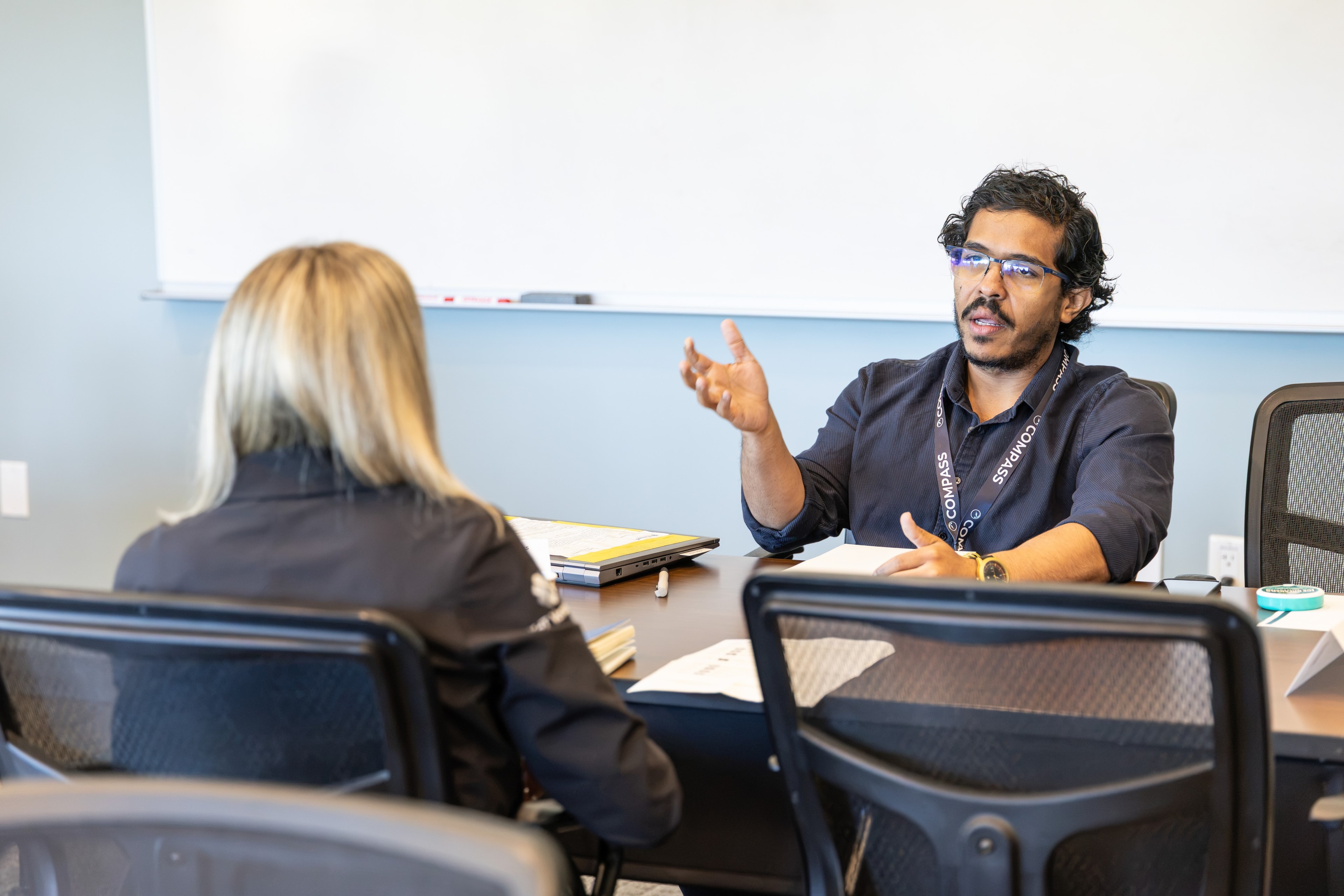
Your research could become a company. Here's how.
COMPASS helps turn breakthrough national lab technologies into venture-backed startups. Whether you want to stay focused on your research or help build the company yourself, there's a path for you.
Your technology, on your terms, with a team behind it.
COMPASS builds the company around your technology with the right team, professional diligence, and venture capital. You'll be involved throughout the process, and you choose how deep that involvement goes.
Your work, validated by the market
Your technology gets evaluated against real market demand and reviewed by active investors who provide direct feedback on what's compelling and what questions remain.
A team built around your science
We put together the best possible team to build a company around your technology, and that team can include you. Your participation shapes the company: from technical guidance during diligence to a hands-on role on the founding team if that's the right fit.
A venture built to scale it
The company is backed by venture capital and guided by investors from the earliest stages, giving your technology a real path from the lab to the market.
Choose your own level of engagement.
There's no single model for how researchers participate. COMPASS is designed to meet you where you are. Policies and available pathways differ by lab, so consult your Technology Transfer Office for specifics on what's possible at your institution.
Stay in the lab
The founding team leads the venture. You contribute technical expertise during diligence and knowledge transfer, then return to your research. You still receive market intelligence, VC feedback, and valuable connections regardless of outcome.
Stay connected
Many researchers want ongoing involvement without going full-time. Advisory roles, technical consultation, and steering committee participation are natural touchpoints that keep you plugged in as the venture takes shape.
Help build the company
If you're interested in a hands-on role, we'll work with you, your TTO, and the founding team to find the right structure, whether that's technical co-founder, founding advisor, or a deep collaboration on product direction.
Real value, whether or not your technology advances.
Every researcher who participates benefits from the process, regardless of whether their technology is selected for venture building.
Actionable market intelligence
Every participating technology receives feedback on positioning, key risks, and where to focus. Intelligence your TTO can use for future licensing, partnerships, or CRADA opportunities.
VC network access
Your technology is reviewed by active investors who provide structured feedback: what's compelling, what the risks are, and what would change their mind. Direct signal from the market.
The right team for your technology
If your technology advances, COMPASS puts together the team to build the company, with the startup and market experience it needs.
Professional due diligence
For the select opportunities that move forward, SRI International runs a 90-day analysis covering market mapping, competitive landscape, technical roadmap, IP posture, and capital planning. This is the kind of work that would cost six figures commercially.
Even if your technology isn't selected for venture building, the program generates connections to existing portfolio companies that might license the technology, collaboration opportunities through lab capabilities and researcher expertise, and comprehensive market intelligence your TTO can act on. Technologies not selected in one cycle can also be recycled into the next batch.
The process, from your perspective.
Here's what participating actually looks like at each stage.
Your TTO nominates your technology
COMPASS works with eight partner DOE national laboratories. Your Technology Transfer Office is the first point of contact. They identify technologies that may be a fit based on shared screening criteria.
Your roleYour TTO may reach out to discuss your technology's fit. You can also proactively flag interest through your TTO.
Questionnaire and interview
You and your TTO complete a screening questionnaire covering the problem your technology addresses, its readiness level, IP status, and your own level of interest in commercialization. The COMPASS core team then conducts a brief interview.
Your roleComplete the questionnaire with your TTO. Participate in a team interview. A few hours total. This is the most researcher-intensive phase.
VC review and Waypoints
Standardized tear sheets are shared with investors for structured feedback. High-potential opportunities are presented at Waypoints, our invitation-only lab-investor summit. The first was held at SLAC in July 2026. It returns in 2027.
Your roleYou may be invited to present at a Waypoints summit and answer investor questions about your technology.
Due diligence
SRI International runs a comprehensive diligence process: market analysis, competitive benchmarking, technical roadmapping, and IP pathway assessment. The founding team comes together and begins direct involvement.
Your roleTechnical Q&A, IP discussions, and lab capabilities overviews. Your participation level is flexible, not required.
Venture building and launch
The founding team incorporates, and COMPASS transfers a $35,000 non-dilutive award to the company. The founding team owns 100% of the company at incorporation. COMPASS takes no equity, and the technology license is negotiated separately with the lab. When it is ready to raise, COMPASS introduces it to the investor network. Pre-incorporation work includes customer discovery, technology validation, and operating plan development.
Your roleThis depends on you. Knowledge transfer is the baseline. Beyond that, your involvement can range from periodic advisory calls to an active role on the founding team.
Screening criteria.
We evaluate technologies across seven dimensions. Knowing the bar helps you self-assess whether your work might be a fit.
Problem & opportunity
Clear buyer, validated pain point, evidence of status quo limitations.
Use case & business model
Quantifiable benefit vs. cost, credible pricing hypothesis, measurable value.
Technology detail
Technology readiness level, development to date, publications, external validation.
Defensibility
Competitive advantage, IP protection, clear ownership or exclusive option path.
Team & engagement
Active PI champion with willingness to engage. No specific role is prescribed.
Market & timing
Compelling “why now” thesis, addressable market of meaningful scale.
Feasibility & risk
Clear milestones, identified dependencies, top risks acknowledged and mitigated.
Not sure? That's fine. Talk to your TTO. The screening process is designed to be exploratory, not punitive.
Where we're looking.
Current opportunity areas span four broad themes, though this list is non-exhaustive and adjusts based on market signals.
Autonomy & intelligent systems
Robotics and autonomous navigation, cyber-physical security for critical infrastructure, perception and sensing stacks with real-world actuation.
Advanced sensing
Resilient PNT and navigation, semiconductor metrology, quantum sensing and space-relevant instrumentation.

Advanced manufacturing
Critical materials processing, manufacturing methods that shift cost and performance curves, supply chain sovereignty.

Energy
Fusion, geothermal, and next-gen fission pathways. Grid infrastructure and enabling components. Data center value chain.
What researchers usually ask.
Think your technology might be a fit?
Talk to your lab's Technology Transfer Office. They're your entry point into the program.